Subway Nearly Mows Down Multiple Track Workers in Astoria

 Subway Tripper

Well it’s official now. If you are a subway track worker, it’s time to take out a little extra life insurance. By the look of things, it is a complete miracle every time you guys make it out of there alive.

You’ve basically got 4 different fault points at any given time where you could die on the tracks. They are: You’re own mistakes, Your supervisor not doing their job, the train drivers not obeying signals, or a technology failure.

Two workers in Queens were nearly mowed down by a train that failed to stop at red signal on September 6th. The Daily News just found out about this open investigation.

Apparently, the men were working as per usual. The supervisor was working along side them, which seems like a nice thing to do, but he should have been SUPERVISING. Why? Because a train decided to blow through a red signal just down the tracks from where they were working.

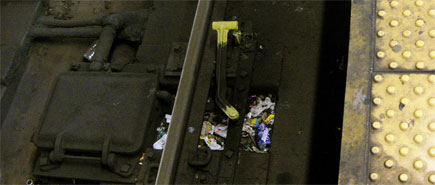
You’ve probably seen a tripper before and didn’t even know it. It looks like a little arm that lifts up just after a train leaves the station (pictured above).  It’s usually covered in black soot except for the top which is painted yellow. Then after the train gets far enough down the tracks, it lowers. If there were to be a runaway train, the tripper would hit the emergency brakes of the train as it rolls by.

That’s what saved the supervisor’s life. The other track workers said he completely froze as the train approached. He just stood there. The tripper hit the emergency brakes, and the train stopped 75 feet away!

“The supervisor was not supervising. He was working and not in tune with keeping us safe,” the second worker wrote in his report of the incident. [Daily News]

So really, what chance could you really stand?

[Photo via Flickr]

19 Year Old Shot in Queens Subway Station

queens.jpg

Jose Sierra, 19, was shot in the head and pronounced dead at the scene. Witnesses say that they heard multiple shots, then saw Sierra laying on the ground with a large hole in his head.

Hopefully, the token booth clerk wasn’t asleep (like this woman) (and this guy) (and this guy) (and this guy) (and this guy) (and don’t forget this guy). WOW. I’m a little nauseous now after seeing all those TWU bastards sleeping on the job. They should be stripped of the union raise that is just handed to them, and it should be given to other workers that actually manage to stay AWAKE during their shift.

Police have no suspects but are looking for some people that were seen running from the scene. No arrests have been made.

This makes us wonder if there was a camera in that station. Wouldn’t you think that there should be a camera at every subway entrance/exit? Is that asking too much? That way, if a crime happens, you know you are going to catch the suspect on film when they enter or exit the station.

This whole topic is just making me too pissed off.

Woah woah woah…slow that fare hike down

Everywhere you turn in the transit world, people are talking about a looming fare hike.  However, as New York State Comptroller Thomas DiNapoli said a few days ago, we need to stop and take a look around.  It might just turn out that “Congestion Pricing” could provide the extra funds we need to avoid a fare hike.

Granted, I don’t know how much I believe that, but it sure would be nice.

It’s my understanding that a portion of the revenue generated, and the federal funds are supposed to go towards improving the transit system.  So the money should not go towards keeping fares down, but instead should go towards improving service.

Maybe a sharp increase in ridership would generate enough revenue to offset the need for another fare hike?  Who knows.

In general, I wouldn’t necessarily mind paying a higher fare if it meant better service.  That includes better trains, more trains, and less unforeseen delays, etc.

There’s another problem that I don’t think gets enough attention.  The MTA receives funds from way too many sources.  It must make the finances in that agency a nightmare.  The MTA gets money not only from fares, but also property sales tax, regular sales tax, and a handful of other areas.

Just the other day, Mayor Bloomberg announced the slashing of sales taxes on clothing items over $110.   Until just recently, shoppers paid about 4% tax to the state, and 4% tax to the city on clothing over $110.  Bloomberg has dropped the city’s portion of that tax, basically cutting the total in half.

However, I’ve heard that the MTA gets something like 0.375% of that revenue.  I guess the question is whether the MTA’s cut comes out of the city’s half or the state’s.  In any event, that’s a prime example of what makes the MTA’s finances so complicated.

There are so many factors that can throw the system’s finances into chaos from year to year.  The whole thing needs to be simplified if we ever plan on getting a grip on the future of city transit.

What A Cluster F*CK! All Subways Fail

Folks, are there really any words to describe this morning?  I don’t even know where to begin.

All I know is that I walked over 50 blocks to get to work this morning.  What a nightmare.  Luckily, I was not caught in the rain, but I might as well have been because I was soaked in sweat. 

So I left my building this morning and turned the corner.  That’s when I saw it.  About 150 people waiting for the bus.  I knew right then that it was going to be a nightmare commute.  So I walked to subway entrance knowing that they couldn’t possibly be running.  There, a transit cop told me there was no service at all on the 1, 2, 0r 3.  Damn it. 

Then I decided to walk over to Central Park to catch the B or C.  Got half way over there, and a fellow straphanger told me not to bother because those trains were out too.  Damn it again.

So I started walking south.  Every block had 30 or 40 people trying to get cabs.  Every bus stop easily had 100+ people waiting.  So I decided to walk down Riverside Drive, hoping that maybe a random cab would be over there.  Nope.  Damn it again.

Then I tried the M5 bus.  At each stop, 2 or 3 buses just blew by the stops.  Even the limited buses weren’t stopping at the limited stops.  How fucked up is that?  People were going bat shit insane. 

So I crossed the UWS back and forth before just sucking it up and walking to midtown.  Each step more sweaty than the next.

I heard an MTA or NYC Transit official on TV literally say, “At this point, we can’t get people from point A to point B on the subway.”  That about sums it up.

How much longer are we going to have to deal with this crappy infrastructure before they do something about it.  A heavy rain is all it takes to throw the city into chaos.  And there’s clearly emergency plan in place to handle this when it happens.  People are just SOL.

Share your war story in the comments.

Report Reveals NYC Transit Worker’s “Casual” Relationship with Safety

In a pointed report released last week, it turns out that the deaths of Daniel Boggs, 41, and Marvin Franklin, 55 were due to clear violations of standard safety procedures.

CityRoom Says:

The reports reveal a safety system so flawed that it is easy to come away with the impression that serious accidents are almost inevitable. That impression is deepened by the description in the reports of a broken safety culture among workers and supervisors, who routinely ignore basic precautions.

You can read the official Boggs report here and the Franklin report here.

In the Boggs report, for example, the conclusion of the investigation places blame on the work gang’s supervisor who failed to stop Boggs and a fellow worker from working unsafely. The supervisor apparently observed the safety violation, but didn’t do anything about it.

NYC Transit Chief Howard Roberts, Jr. pointed out in a news conference, “The problem is not the rules as much as it is to get a situation in which people live those rules.”

So basically, NYC Transit is taking the position that the appropriate safety rules are already in place. The problem is a general attitude among the workers to ignore the rulebook whenever they see fit. At least that’s the conclusion of these reports.

In both cases, the reports point out specific safety regulations that were violated during the work in question.

Elderly Rejoice. Subway Elevators and Escalator Status Available Online

mta-2.gifStarting today, subway riders can visit the MTA website to find out about elevator and escalator outage information.  The page is updated three times a day.  So now you can find out that you’re shit out of luck from the comfort of your own home. 

Did you know…

NYC Transit has 158 elevators and 169 escalators.

While that does not seem like enough in today’s ADA world, it seems like way more than I’ve ever noticed.  If I think really hard, I can think of maybe a dozen or two places where there’s an escalator or elevator.  So the fact that there are over a hundred of each is quite surprising to me. 

Anyway, the MTA admits that they are way behind on making stations ADA compliant.  That’s what this guy has been screaming about for quite some time now. 

Apparently, there is hotline that has been around just for this.  Who knew?  So now the website will reflect the same kind of information that is available over the phone. 

Read the press release

EMT’s On the Subway? Nah.

The MTA is thinking about cutting a program that puts first aid workers in the subways.  They think by cutting the program, they can save a whopping $250,000 a year.  If you ask me, they could fire a few of the “captain obvious” system public address announcers and save about the same amount too.

From the Daily News:

For nearly a decade, medical professionals – first nurses and then emergency medical technicians – have been posted at some of the busiest stations to help ill travelers, remove them from trains as quickly as possible and clear traffic jams on the rails. EMTs now work at seven stations.

However, in the next breath, the MTA says that there are 430 medically related delays per month.  Doesn’t that sound like a lot?  So you actually want to cut the medical aid program?  Huh?

The thing is actually called the “Sick Passengers Response Program.” 

Ok, so we have all been screwed by the “Because of a sick passenger at _____ street, this train will be running _______ (not where you want to go).”  Now, if there’s no medical staff at the major stops, won’t it take longer to get these people help?  We all know that they aren’t going to do what they should do, and just dump the person on the platform, and keep going. 

Clearly, only a few stops have staffed EMTs now, so I would suggest adding MORE medical staffed stops.  That way they can get the sick people off the trains faster, and cut down on the 400+ monthly delays.

MTA Could Move on Fare Hike TODAY

Published reports say that the MTA could vote on its first fare hike in four years as early as today!  😦 

If an increase is on the agenda, there won’t be a decision until December. But the MTA board could decide today to schedule public hearings on fare hikes for New York City Transit, the Metro-North Railroad and the Long Island Rail Road. (AP)

The City’s Independent Budget Office did a review of the books and it seems that at 20% base fare increased would be needed by 2010 to fight mounting debt.  That would put the standard far at about $2.40. 

Free bus-to-subway transfers and MetroCardsthat allow unlimited trips for one price over seven or 30 days have dropped the average cost of a ride to $1.28, which is lower than it was in 1996, according to MTA monthly reports. Longtime board member Barry Feinstein, who said he was not privy to budget strategy, vowed he would not support anything that means a step backward for the system.

Where’s Captain “No Fare Hike” Spitzer on this issue?  Too busy battling it out with Bruno I guess.  Clearly this increase is the exact opposite of what he promised in his election campaign.  However, at this point, politicians making promises and then not delivering shouldn’t be a shock to anyone.  Let’s hope he speaks up soon.

Anyway, I’m not opposed to a fare hike if it is the only way to keep the system from going under.  Listen, I understand that things cost money, and that things are always going to get more expensive.  Unfortunately, there’s that lingering feeling that if money were managed more efficiently, this wouldn’t be a problem. 

On that note, if there’s going to be a fare hike, at least make it a good one.  Let’s say the fare does go up to $2.40.  That increase is only designed to maintain the status quo.  That means that we would be stuck with the same issues that we are faced with now:  dirty subways, failing equipment, and lack of consistent service.  I’d rather bump it up to $3.00 if it means that all the subway platforms can get a face lift, more trains can be put into service, and the equipment system wide get’s updated.  I have no problem paying more if it means that there’s going to be some sort of benefit. 

Paying an extra $0.40 on a base fare just to keep the MTA’s head above water doesn’t seem smart.  Might as well take the opportunity to make a big splash.  That is of course under the assumption that the only way to solve this problem is a fare hike…of which I think we are all a bit suspicious. 

Rainy Eve Day of the Subway’s Report Card

Yeah, so it’s rainy as hell, but at least it’s a little cooler out today. That’s a refreshing change.

Unfortunately, it is still humid as hell on the subway. I had the unlucky fortune of getting on car without air conditioning. It was just as crowded as always, so that kinda kept me from being able to jump ship and run to another car. There was a high risk that I might not have been able to get back on board. With the poor reliability of service in heavy rain, I wasn’t about to get out, miss the train, and wind up stuck on the platform forever.

In other news, the Straphanger’s Campaign State of the Subway report comes out tomorrow today (damn you day old wire story)!! In a sneak peak, it seems that the R and W trains aren’t getting a good rating (shock and awe). As a matter of fact, the report is going to be released outside City Hall’s R and W station.

Last year, the 6 train was rated highest. SUBWAYblogger doesn’t think that will be the case this year.

The report should be especially interesting considering the changes that lie on the horizon. Increased fares, congestion pricing, and the behemoth Second Avenue line. This report should be a fairly accurate barometer for telling us if the system can handle the increased load.

Obviously, without even looking at the report, we all know that that the answer is NO. However, now that Bloomberg was able to push congestion pricing through, the City will be eligible for $500+ million in funds to improve the infrastructure. So, much of that cash **should** be going toward improving mass transit as well as getting the toll system up and running.

So, the worst rated lines might be the best areas to start improvements. We’ll see.